Gerhard Richter’s artistic explorations, which stretch over more than six decades, constitute a radical attempt to integrate representation and abstraction. Known for his painted copies of black and white photographs rendered with a blurred effect, Richter has broadened the potentials of both photography and painting.

Interested in Gerhard Richter?
December 2020 (A – F)
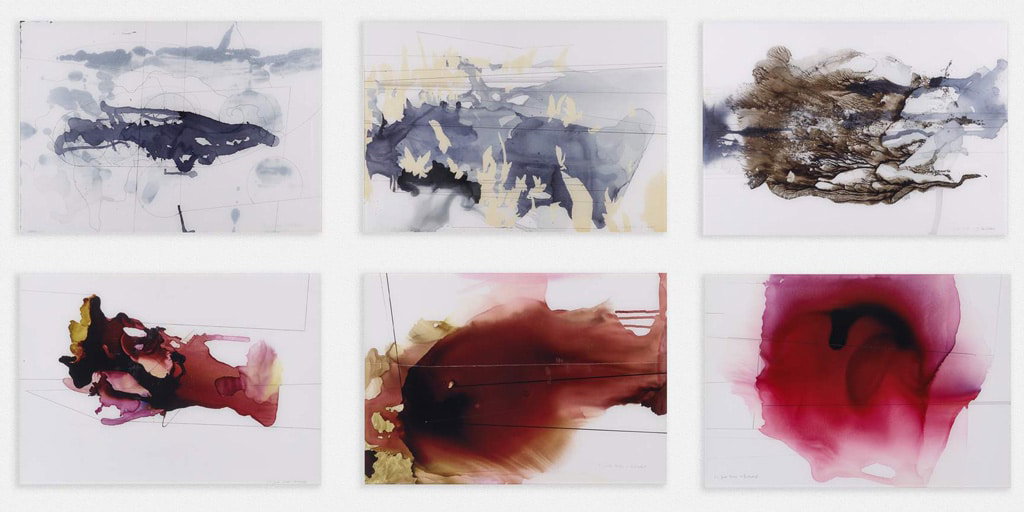
We are thrilled to announce the release of six new works by Gerhard Richter titled December 2020 (A – F), published in a limited edition of 25 + 5 AP, each numbered and signed by the artist.
Following a period of rich experimentation throughout 2020, Gerhard Richter based these editions on a series of new watercolours on paper, reproducing them in full scale. Billowing forms in shifting registers of red and blue course across white fields, hinting towards the picture’s own internal space and the slightest suggestion of landscape or sky. Linear markings in graphite express an internal architecture and logic in contrast to the unpredictable instability of watercolour, anchoring the free flowing forms which risk breaching the field’s constraints.
Cage
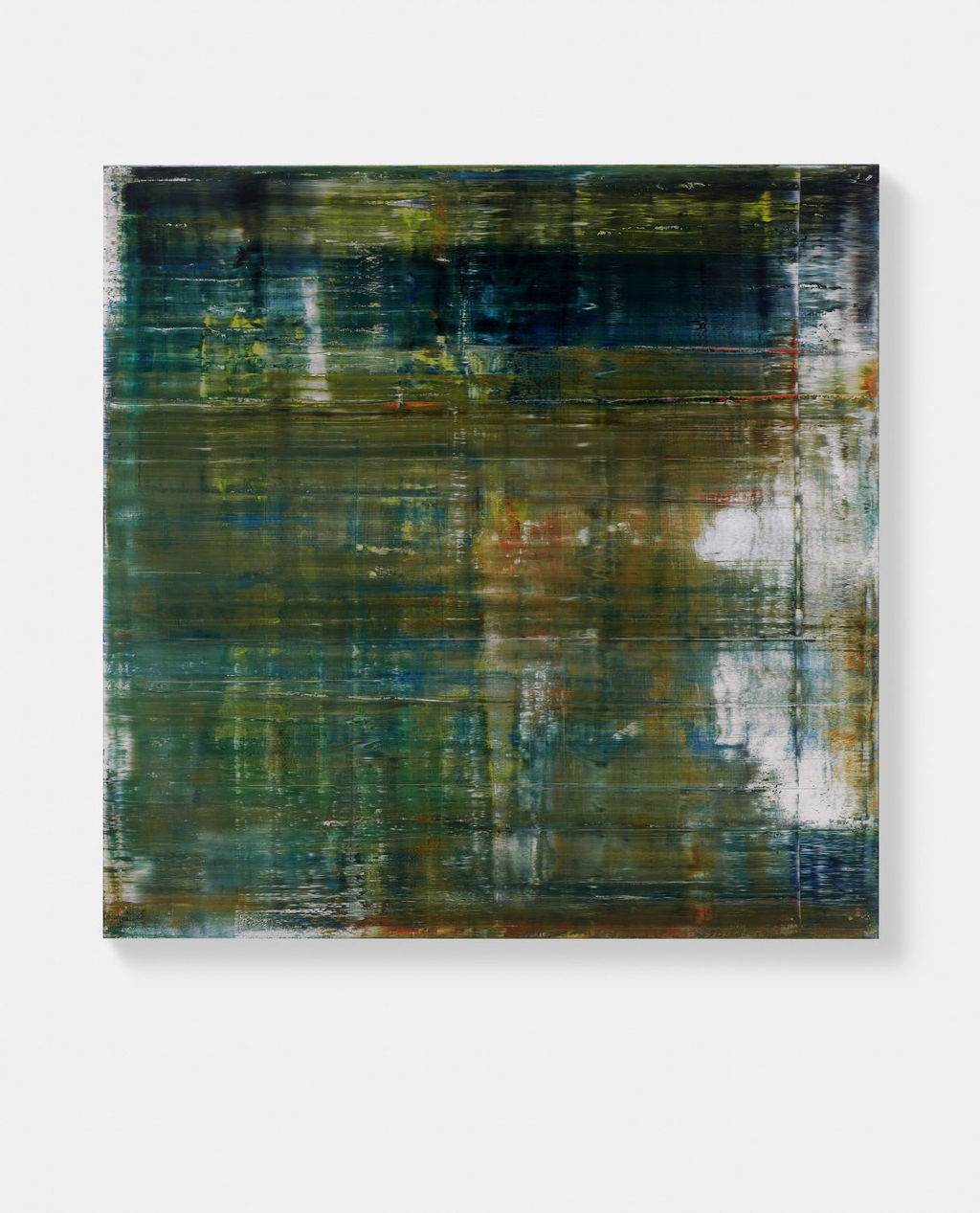
Gerhard Richter’s series of six ‘Cage’ prints (P19, 2020) were based off his monumental ‘Cage Paintings’, created in 2006. For the Gagosian Gallery premiere in June 2021 they were accompanied by a recital featuring rock icon Patti Smith. “Everybody has a song which is no song at all”, said Smith. “It is a process of singing and when you sing you are where you are”. Her evocative words capture the essence of the exchange between the painting and print.

Waldhaus
Gerhard Richter’s life-long preoccupation with technology and alternative means of artmaking is embedded in ‘Waldhaus’ (P18, 2018), a facsimile print after the original oil on canvas from 2004. Richter’s painting began as a photograph of a house within a vast green forest which culminates in hilly peaks.

Tulips
Gerhard Richter’s 1995 oil on canvas ‘Tulips’ is a standout work from his acclaimed photo paintings series. The work began as a photograph from ‘Atlas’, Richter’s collection of photographs, newspaper cuttings and sketches which he has assembled since the 1960s, of a bouquet of yellow tulips in a green vase. This image is seemingly rendered through chiaroscuro as a spotlight appears to highlight the buds.

Flow
One of the captivating facsimiles produced after Gerhard Richter’s acclaimed ‘Flow’ series paintings from 2013 is ‘Flow’ (P16, 2016). The painting was produced by pouring enamel paints in shades of blue, black, pink, green, red and yellow onto a flat surface and allowing them to merge and flow. Richter temporarily held off interference and allowed the paints to construct compositions autonomously, such as the waves of colour in the work's upper left corner and the mountain-like peaks at its centre.

Flow
Gerhard Richter’s ‘Flow’ (P15, 2016), a facsimile print after a painting from the eponymous 2013 series, displays large fields of deep green, pink and yellow, streaked with white and black strokes. A strikingly dynamic composition, this work nonetheless conveys subtle representational suggestions, its wild colour interactions recalling powerful waves or raging storms. The kinetic figuration was composed through Richter’s application of enamel paints onto a surface, which were subsequently allowed to freely move and mix.

Fence
Gerhard Richter’s ‘Fence’ (P13, 2015) is an exquisite facsimile produced after the artist’s haunting original oil painting ‘Fence’ (2008) from his photo paintings series.

Annunciation after Titian
Gerhard Richter was first acquainted with Titian’s ‘Annunciation’ (1540) in 1972, when he exhibited his series ‘48 Portraits’ (1971-98) at the Venice Biennale. Titian’s painting, held at the Scuola Grande di San Rocco, so fascinated the painter that he bought a postcard of the masterpiece and began making copies once back in his studio in Germany.


15:48
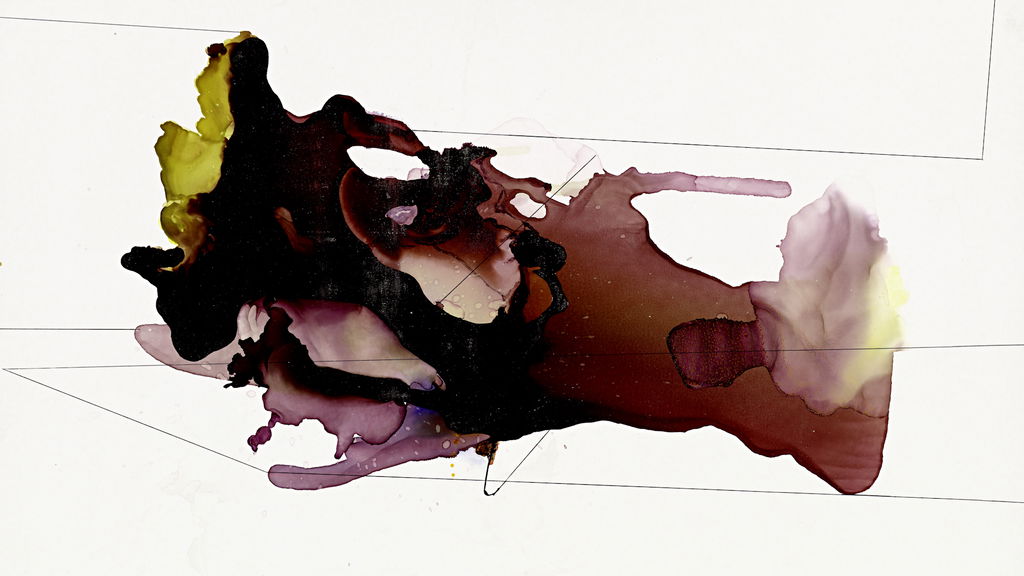
Gerhard Richter: Drawings
‘The drawings are traces of a life, creating territories in relation to limits and potentials. Communications transmitted to whoever will regard them.’ — Prof. Michael Newman
12:00
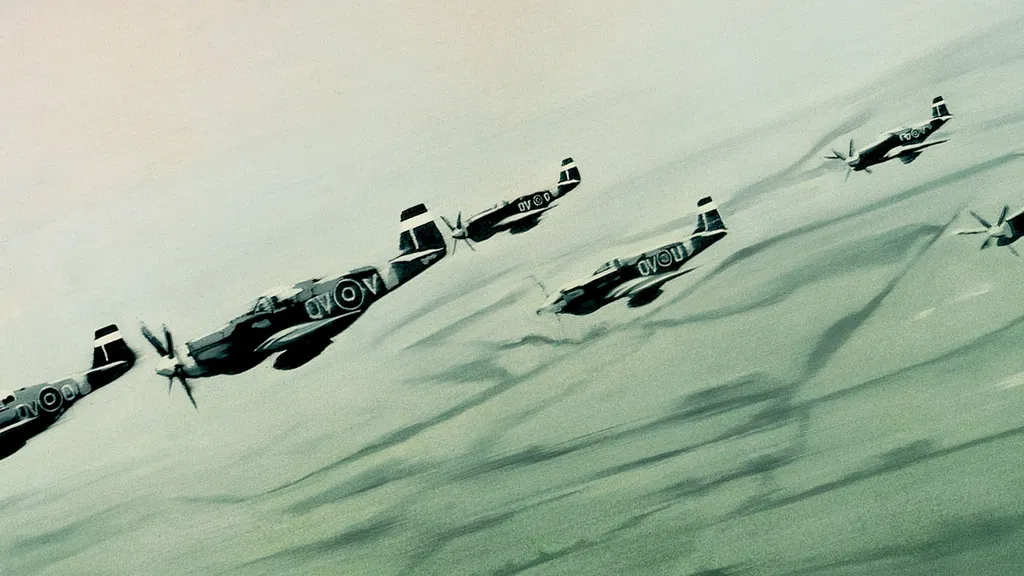
Gerhard Richter: Doubt
‘He disturbed my sense of what art should be.’ — Robert Storr on Gerhard Richter

1:19
1 Minute 1 Work: Gerhard Richter, Ema (Nude on a Staircase), 1966
Writer Robert Storr examines Gerhard Richter’s ‘dissenting’ painting ‘Ema (Nude on a Staircase)’.

11:49
Reflecting on Gerhard Richter
An exploration of the processes of leading artist Gerhard Richter as presented through his glass sculptures and paintings.

1:14
1 Minute 1 Work: Gerhard Richter, Annunciation after Titian, 1973
Learn about Richter’s ardent commitment to Titian’s canvas — and the impossibility of such a painting for our times — with writer Robert Storr.
About the Artist
Gerhard Richter’s artistic explorations, which stretch over more than six decades, constitute a radical attempt to integrate representation and abstraction. Best known for his painted copies of black and white photographs rendered with a blurred effect, Richter has broadened the potentials of both photography and painting.
Born 1932 in Dresden, Germany, Richter’s childhood was affected by the rise of the Nazi regime and the traumatic events of World War II. According to some of his critics, these painful memories, combined with a regimented life in East Germany under Soviet rule, discouraged him from conveying ideological expressions through art. Such unpretentious perspective materialises in his continued focus on colour combinations and on the tangible quality of his canvases.
Richter began his studies at the Dresden Art Academy in 1951, but disliked their dogmatic emphasis on Social Realist art. In 1961, Richter fled to West Germany where he studied at the Kunstakademie Düsseldorf. In this liberated, experimental environment, Richter first produced his photopaintings.
Richter admits Pop Art gave him the license to use photography in his photopaintings. Like Warhol, he saw in photography’s mechanical recording a way to build a machine-like aesthetic that denied artistic involvement. Sourcing photographs from family albums, newspapers and magazines, Richter was interested in the photograph’s status as reproduction, as one stage removed from reality. The photopaintings function like echoes of distant worlds. This dissociation from the subject was developed in his signature blur, created by running a dry brush through the wet paint. In the photopaintings of his family, these distancing effects resonate a sense of confusion of how to make sense of their difficult history.
Richter advanced this dissociative language in his printmaking practice. From his early editions, such as ‘Dogs’ (1965), to the 2017 Giclée print of ‘Tulips’ (1995) the artist employs the medium as an extra layer of aesthetic distance, being based off a painted image. At the same time, the print completes the work’s cycle, which started with a photographic image that was abstracted in paint and ended with the painted image returned to its photographic state.
Alongside his photopaintings, Richter has developed new possibilities for abstract art which build on his aesthetic of non-involvement. The first abstract series ‘Colour Charts’ (1966) was based on paint charts found in hardware stores and reproduce their geometric grids of colour. Later geometric abstractions used a random computer-generated selection to arrange colours by chance. One of his most intricate, ‘4096 colours’ (1974) would inform the design of Richter’s monumental stained glass windows for the south transept of the Cathedral of Cologne (2007).
Unwilling to stick to one genre, in his ‘Works Behind Glass’ (2008-10) Richter embraced a free form abstraction. In these, poured enamel paint is squelched flat between glass sheets. Recreated as print editions, the Diasec-mounted chromogenic print on aluminium brilliantly captures the harsh flattening effects of the glass; indeed, the flattening becomes more extreme in the print as the layers of physical paint are less distinguishable. The spectator is invited to abandon themselves to the Dionysian swirls of paint.
The diversity of Richter’s oeuvre is remarkable, but equally extraordinary is the consistency of his vision. Throughout his work, he promotes an art that denies artistic involvement. Through this, Richter lays bare a natural beauty: from his tender and diffuse early photopaintings to the vibrant exaltation of colour in his glass paintings.