Art of Architecture
Peter Cook
£35.00
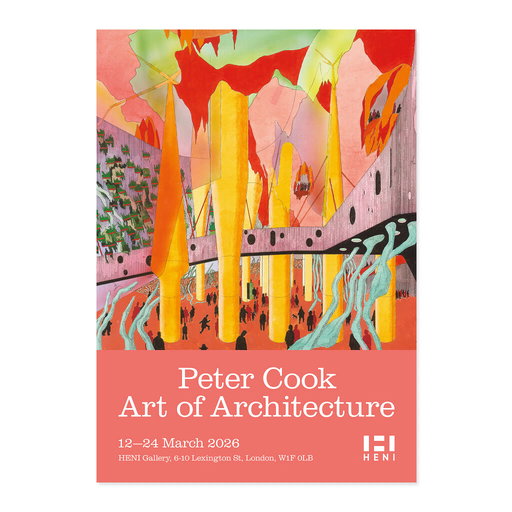
While for many architects, drawing is a functional tool in the development of specific building projects, visionary British architect Sir Peter Cook has used the medium throughout his long career to channel his boundless imagination. From those made in the 1960s at Archigram to the present day, Cook’s colourful, highly detailed images resonate beyond the architectural sphere, as seen in his major solo exhibition at the Louisiana Museum of Modern Art, Denmark in 2022. Cook’s work pushes the boundaries of architectural norms of design and construction, with the freedom to imagine buildings, communities and cities that are, as he succinctly puts it, ‘possible or maybe nearly possible, but importantly, not consciously impossible’.
For this book, Cook has selected the 18 projects — 16 drawings, one building and his Serpentine Play Pavilion — that he considers most essential to understanding his creative process. These are accompanied by texts that set them within a historical, cultural and personal context. His unorthodox and varied 60-year career is explored further in a conversation with Serpentine’s Artistic Director, Hans Ulrich Obrist, that delves into Cook’s personal history, belief systems and creative processes from childhood to the present day.
Publication:
March 2026
Illustrations:
79
Dimensions:
300 x 300 mm
Format:
Paperback
ISBN:
978-1-911736-32-5
No. of pages:
144
Sir Peter Cook (b.1936) is a British architect and co-founder of Archigram. Founding Partner of the Cook Haffner Architecture Platform (CHAP), Cook is a former Director of the Institute for Contemporary Art, London (ICA) and Bartlett School of Architecture at University College, London. In 2002 Cook was awarded RIBA’s highest award, the Royal Gold Medal, and in 2007 knighted by Queen Elizabeth II for his services to architecture. Cook’s drawings are held in the collections of major museums around the world including the Museum of Modern Art, New York; Centre Pompidou, Paris; M+ Museum of Art, Hong Kong and Victoria and Albert Museum, London.